Filter
19
Breadcrumb:
Malaria Consortium
Featured
3
Language
Document type
6
4
2
2
1
1
1
1
1
Countries
3
3
2
2
1
1
1
Authors & Publishers
Publication Years
Category
6
4
3
3
1
Toolboxes
3
2
2
2
2
1
1
1
1
1
1

Mozambique was the first country outside of the Sahel to successfully implement seasonal malaria chemoprevention (SMC) on a large scale. This learning paper captures some of the lessons drawn from the implementation process.
Moçambique foi o primeiro país fora da região do Sahel a expandir com sucesso a quimioprevenção sazonal da malária (QSM). Neste documento de aprendizagem, descrevemos as lições decorrentes da aplicação em larga escala da QSM em Moçambique.

The Malaria Consortium website provides comprehensive information about the organization’s work in preventing, controlling, and eventually eliminating malaria and other communicable diseases. It showcases the organization’s projects, research, publications, and policy work across Africa and Asia
...
The webinars aim to create awareness and convene discussion, bringing together Malaria Consortium technical experts and programmes teams with other actors working on the effective delivery of national and global health interventions worldwide.

The 2025 Impact Report summarises Malaria Consortium's year in numbers and includes a message from the Chief Executive.

Position Statement

Thematic brief. This brief highlights the link between climate change and VBDs
in Asia Pacific. Using malaria to tell the narrative, it lists key actions that policymakers and the public health community can consider in addressing the impact of a changing climate on health. The brief also includes
...
Antimicrobial resistance (AMR) is a growing threat to our health, causing at least 700,000 deaths globally every year. The death toll attributed to AMR is predicted to rise, with most lives lost in low and middle income countries (LMICs).
AMR is also a critical challenge for many other sectors, inc
...
Integrated community case management (ICCM) – an approach where community-based health workers are trained to identify, treat and refer children under-five with pneumonia, diarrhoea and malaria – is increasingly being used across sub-Saharan Africa to supplement the gaps in basic healthcare prov
...
In the context of the Support to National Malaria Control Programme (SuNMaP), demand creation is the strategic combination of advocacy, communication and mobilisation approaches that seek to achieve increased community awareness of, and demand for, effective malaria prevention and treatment services
...

This implementation plan sets out a series of programmatic objectives, activities and outcomes for malaria surveillance strengthening in Myanmar over the next two years. This period represents a key phase as the National Malaria Control Programme (NMCP) strives to build on recent achievements in str
...
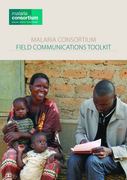
This Communications Toolkit is intended to provide practical guidance and support to staff and partners who are looking to increase their communications capacity. It has been developed as a resource for project staff who work at field-level, to help them communicate responsibly, creatively, and effe
...
The primary aim of this assessment is to evaluate current approaches to malaria surveillance in Myanmar and to provide a set of practical and feasible recommendations to further strengthen the surveillance system in the short to medium term. The assessment focuses on the surveillance of malaria case
...
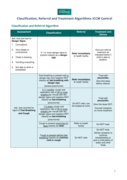
The document "Classification and Referral Algorithm – iCCM Uganda" (2013) by Malaria Consortium provides a practical guide for community health workers to assess, classify, and manage common childhood illnesses in Uganda. It focuses on key symptoms such as fever, cough, diarrhoea, and danger signs
...
This learning paper describes Malaria Consortium’s experience with Integrated Community Case Management (ICCM) in malaria prevention and treatment in Mozambique and Uganda. ICCM is an approach where community-based health workers are trained to identify, treat, and refer complex cases malaria (an
...
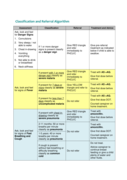
The document titled "Classification and Referral Algorithm – iCCM South Sudan", published by Malaria Consortium in 2012, provides a practical tool for community health workers to assess, classify, and manage common childhood illnesses in South Sudan. It outlines step-by-step procedures for identif
...