
Filter
568
Featured
2
5
Language
Document type
248
79
64
42
35
22
16
14
12
10
10
8
7
1
Countries
353
64
16
12
8
6
4
4
4
3
3
2
2
2
2
1
1
1
1
1
1
1
1
1
1
1
1
1
Authors & Publishers
Publication Years
Toolboxes
540
10
3
3
3
2
1
1
1

The "Stories from the field" document by the WHO Regional Office for the Eastern Mediterranean shares effective strategies from the Eastern Mediterranean Region for addressing noncommunicable diseases (NCDs) and mental health challenges, particularly during the COVID-19 pandemic. It highlights regio
...
The report "Assessing National Capacity for the Prevention and Control of Noncommunicable Diseases" provides an overview of the capacities of countries in the Eastern Mediterranean Region to address noncommunicable diseases (NCDs) based on a 2019 survey. It evaluates the progress of 22 countries in
...
The WHO document, "High-level technical meeting on noncommunicable diseases and mental health in small island developing states: summary brief," outlines the outcomes of a January 2023 meeting in Barbados, focusing on NCDs and mental health challenges in small island developing states (SIDS). Key to
...
The "Global mapping report on multisectoral actions to strengthen the prevention and control of noncommunicable diseases (NCDs) and mental health conditions" by the WHO provides insights into how different countries are implementing multisectoral approaches to address NCDs and mental health issues.
...

This document highlights landmarks and key milestones in the development and implementation of the global agenda for noncommunicable diseases (NCDs) over the last two decades. It summarizes where the world was in 2000, where it is in 2022, and where the world wants to be in terms of NCD prevention a
...

The WHO document "Integrating the prevention and control of noncommunicable diseases in HIV/AIDS, tuberculosis, and sexual and reproductive health programmes: implementation guidance" provides a framework for integrating noncommunicable diseases (NCDs) into existing health programs for HIV/AIDS, tub
...

The coronavirus disease (COVID-19) pandemic exacerbated pre-existing inequalities in the treatment and care of noncommunicable diseases (NCDs). This report examines the effect of the COVID-19 pandemic on access to NCD medicines, and the policies and strategies implemented by countries and health sys
...
Noncommunicable diseases (NCDs) – chief among them, cardiovascular diseases (heart disease and stroke), cancer, diabetes and chronic respiratory diseases – cause nearly three-quarters of deaths in the world. Their drivers are social, environmental, commercial and genetic, and their presence is g
...
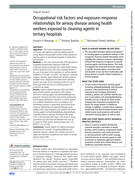
This study investigated occupational risk factors and exposure–response relationships for airway disease among health workers (HWs) exposed to cleaning agents in two tertiary hospitals in South Africa and Tanzania.
Previous studies have demonstrated an association between asthma or respiratory
...
The webpage from the Institute for Health Metrics and Evaluation (IHME) features a podcast discussing chronic respiratory diseases and their global impact. It highlights the growing burden of diseases such as chronic obstructive pulmonary disease (COPD) and asthma worldwide. The podcast provides ins
...

The Cedars-Sinai webpage on occupational lung diseases provides an overview of various lung conditions caused by exposure to harmful substances in the workplace. It outlines common types of occupational lung diseases, including asbestosis, silicosis, coal workers’ pneumoconiosis, and chemical-rela
...
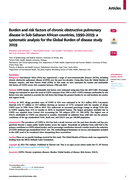
The article analyzes the prevalence and risk factors of chronic respiratory diseases, focusing on sub-Saharan Africa. It highlights that environmental exposures, such as biomass fuel usage and air pollution, significantly contribute to respiratory health issues in the region. The research underlines
...
The WHO fact sheet on household air pollution highlights that around 2.1 billion people rely on solid fuels like wood and coal for cooking, using open fires or inefficient stoves. This leads to severe indoor air pollution, contributing to about 3.2 million premature deaths each year, including over
...

The WHO fact sheet on household air pollution highlights that around 2.1 billion people rely on solid fuels like wood and coal for cooking, using open fires or inefficient stoves. This leads to severe indoor air pollution, contributing to about 3.2 million premature deaths each year, including over
...

The WHO fact sheet on household air pollution highlights that around 2.1 billion people rely on solid fuels like wood and coal for cooking, using open fires or inefficient stoves. This leads to severe indoor air pollution, contributing to about 3.2 million premature deaths each year, including over
...
Worldwide, around 2.3 billion people still cook using solid fuels (such as wood, crop waste, charcoal, coal and dung) and kerosene in open fires and inefficient stoves. Most of these people are poor and live in low- and middle-income countries. There is a large discrepancy in access to cleaner cooki
...
The WHO fact sheet on household air pollution highlights that around 2.1 billion people rely on solid fuels like wood and coal for cooking, using open fires or inefficient stoves. This leads to severe indoor air pollution, contributing to about 3.2 million premature deaths each year, including over
...

The World Health Organization (WHO) fact sheet on Chronic Obstructive Pulmonary Disease (COPD) provides an overview of this common lung condition characterized by persistent respiratory symptoms and airflow limitation.
The World Health Organization (WHO) fact sheet on Chronic Obstructive Pulmonary Disease (COPD) provides an overview of this common lung condition characterized by persistent respiratory symptoms and airflow limitation.
The World Health Organization (WHO) fact sheet on Chronic Obstructive Pulmonary Disease (COPD) provides an overview of this common lung condition characterized by persistent respiratory symptoms and airflow limitation.
