
Filter
85
Featured
7
2
Language
Document type
32
16
11
8
5
5
3
2
2
1
Countries
5
2
1
1
1
Authors & Publishers
Publication Years
Category
5
3
1
1
)الرمد الحبيبي( وتوزيعه وإدارته للقضاء عىل التراخوما Zithromax® كيفية التقدم بنجاح للحصول عىل تبرع
Trachoma is the leading infectious cause of blindness (2). It is characterized by repeated
conjunctival infection with particular strains of Chlamydia trachomatis. This scars the conjunctivae and,
in some cases, leads to trichiasis with or without entropion. The abrasive action of eyelashes can
d
...
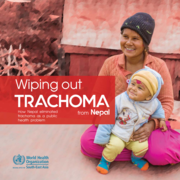
Wiping out Trachoma from Nepal – How Nepal eliminated trachoma as a public health problem
WHO - 2018

In 2018, we are celebrating 20 years of progress in eliminating trachoma, the world’s leading infectious cause of blindness. Set up in 1998 by Pfizer Inc. and the Edna McConnell Clark Foundation, the International Trachoma Initiative (ITI) supports Ministries of Health in over 30 countries around
...
Contemporary data for causes of vision impairment and blindness form an important basis of recommendations in public health policies. Refreshment of the Global Vision Database with recently published data sources permitted modelling of cause of vision loss data from 1990 to 2015, further disaggregat
...
The Fifty-first World Health Assembly adopted resolution WHA51.11 in 1998, which targets the
global elimination of trachoma as a public health problem by 2020 (1). The strategy recommended
to achieve that goal is encapsulated by the acronym “SAFE”, which represents: Surgery for
individuals wi
...
En 1998, la Cinquante-et-Unième Assemblée mondiale de la Santé a adopté la résolution
WHA51.11 qui vise l’élimination mondiale du trachome en tant que problème de santé publique
à l’horizon 2020 (1). La stratégie recommandée pour atteindre cet objectif est récapitulée dans
le sig
...
La quincuagésima primera Asamblea de la Salud Mundial aprobó la resolución WHA51.11 en
1998, que busca la eliminación mundial del tracoma como problema de salud pública para el 2020
(1). La estrategia recomendada para lograr ese objetivo está encapsulada por las siglas "SAFE", que
represent
...

More and more countries are completing their epidemiological mapping of trachoma in suspected
endemic districts and are preparing to distribute Zithromax® in those districts where the prevalence of
“trachomatous inflammation – follicular” (TF) is above 5% among children aged 1-9 years. Mass
...

These standard operating procedures are intended to be used when a Member State wishes to request validation of national elimination of trachoma as a public health problem following implementation of the SAFE strategy,1 which comprises: surgery for trachomatous trichiasis, antibiotics to clear infec
...

Ce modèle vise à aider les administrateurs des programmes nationaux de lutte contre le trachome à préparer
un dossier rassemblant les données factuelles à présenter à l’OMS pour solliciter la validation de l’élimination
de cette maladie en tant que problème de santé publique. Ces in
...
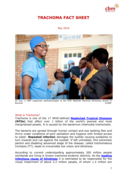
Trachoma is one of the 17 WHO-defined Neglected Tropical Diseases
(NTDs) that affect over 1 billion of the world’s poorest and most
marginalized people. It is caused by the bacterium chlamydia trachomatis.
International commitment to eliminate trachoma as a public health problem worldwide is supported by resolution WHA51.11 of the World Health Assembly .1 Important progress towards this goal has been made by harnessing the mostly informal relationships that exist between partners including Member Stat
...
SECOND MEETING REPORT
DECATUR, GA, USA, 26 JUNE 2016
Over the course of their lives, women spend more time with children than men. Because young children are the reservoirs of trachoma infection, contact with them can result in more frequent trachoma infection. This gender-specific exposure to trachoma risk factors places women at a higher risk for tr
...

The year 2020 is the target date for the elimination of blinding trachoma as a public health problem. There has been great progress, and there is unprecedented funding available – particularly from DFID, the Queen Elizabeth Diamond Jubilee Trust, and USAID. There is also reason for optimism that,
...
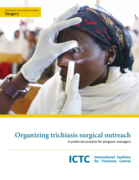
A key component of elimination is to reduce the number
of unmanaged trachomatous trichiasis cases to less than
1 per 1,000 population in affected areas. This will require
not only a large increase in the number of surgeries
performed, but also improvements in the quality of surgery
and in the e
...
Video. Nieba was born and raised in the village of N’Gara in Mali. Nieba suffered from trichiasis, an advanced stage of trachoma whereby the eyelashes turn inwards and scratch the cornea, leading to irreversible blindness.
The Lancet Volume 384, Issue 9960p2142-2152December 13, 2014
This article is available free of charge. Log in or register for free to read the full article.
In order to target resources and drugs to reach trachoma elimination targets by the year 2020, data on the burden of disease are required. Using prevalence data in African countries derived from the Global Atlas of Trachoma (GAT), the distribution of trachoma continues to be focused in East and West
...
