
Filter
285
Featured
36
19
Language
Document type
170
23
21
20
16
10
8
8
7
1
1
Countries
22
21
13
11
10
10
10
5
4
3
2
2
2
2
2
2
2
2
2
1
1
1
1
1
1
1
1
1
1
1
Authors & Publishers
Publication Years
Category
30
6
5
3
1
1

В качестве социальных предикторов, определяющих рост частоты психических заболеваний, рассматривают процессы урбанизации, стрессогенные события и другие социалÑ
...

В методических рекомендациях рассматривается разработанная авторами модель социально-психологической помощи пациентам, страдающим шизофренией. На основе резулÑ
...

Разработанный авторами тренинг направлен на формирование, развитие и восстановление у пациентов, страдающих шизофренией, навыков общения, приобретение ими опыта
...

Цель: анализ уровня тревожности и тяжести депрессии у больных рассеянным склерозом. Материал и методы. Чтобы определить уровень депрессии и тревожности у больных Ð
...
Mood disorders
Chapter E.2
Other disorders
Chapter H.5
Q 12: In children and adolescents with anxiety disorders, what is the effectiveness and safety, considering system issues in low- and middle-income countries, of using pharmacological interventions in non-specialist settings?
Roubles de l’humeur
Chapitre E.4
Edition en français Traduction : Cora Cravero Sous la direction de : David Cohen Avec le soutien de la SFPEADA

Autres troubles
Chapitre H.5
Edition en français Traduction : Bojan Mirkovic Sous la direction de : Priscille Gérardin Avec le soutien de la SFPEADA
Learning objectives
• Promote respect and dignity for people with self-harm/suicide.
• Know the common presentations of self-harm/suicide.
• Know the principles of assessment of self-harm/suicide.
• Know the management principles of self-harm/suicide.
• Perform an assessment for self-
...
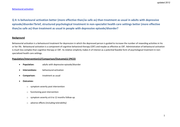
Q 4: Is behavioural activation better (more effective than/as safe as) than treatment as usual in adults with depressive episode/disorder?brief, structured psychological treatment in non-specialist health care settings better (more effective than/as safe as) than treatment as usual in people with de
...
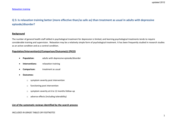
The number of general health staff skilled in psychological treatment for depression is limited, and learning psychological treatments tends to require considerable training and supervision. Relaxation may be a relatively simple form of psychological treatment. It has been frequently studied in rese
...
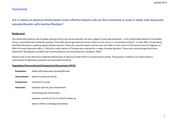
Q6: Is advice on physical activity better (more effective than/as safe as) than treatment as usual in adults with depressive episode/disorder with inactive lifestyles
Depression Research and Treatment
Volume 2012, Article ID 962860, 8 pages
doi:10.1155/2012/962860

The Georgetown Undergraduate Journal of Health Services (2), 2012.
Q1: In individuals with psychotic disorders (including schizophrenia), are antipsychotic drugs safe and effective?
Q2: In individuals with psychotic disorders (including schizophrenia), is the use of two or more antipsychotic medications concurrently more effective and safer than the use of one antipsychotic only?
