
Filter
888
Featured
133
72
Language
Document type
185
164
154
83
60
57
57
39
30
23
15
13
3
2
Countries
38
30
24
24
22
20
16
8
7
7
6
6
6
6
6
5
4
4
4
4
4
4
3
3
3
3
3
3
3
3
2
2
2
2
2
2
2
2
2
2
2
2
2
2
2
2
2
1
1
1
1
1
1
1
1
1
1
1
1
1
1
1
1
1
Authors & Publishers
Publication Years
Category
175
143
128
108
94
50
5
1.0 PURPOSE
To define the procedure for the conduct of in-person meetings in both healthcare and community settings in response to COVID-19 and with respect to Public Health and Social Measures (PHSMs) to reduce the risk of disease transmission. A general risk assessment must be conducted to inform
...

Standard precautions aim to protect both health workers and patients by reducing the risk of transmission of microorganisms from both recognized and unrecognized sources. They are the minimum standard of infection prevention and control practices that should be used by all health-care workers, durin
...
Transmission-based precautions for the prevention and control of infections: aide-memoire
recommended
Transmission-based precautions (TBP) are used in addition to standard precautions for patients with known or suspected infection or colonization with transmissible and/or epidemiologically significant pathogens. The type of TBP assigned to a patient depends on the transmission route of the microorga
...
Nurses are key players in health promotion and disease prevention and the backbone of health care systems worldwide. Nurses work on the front lines of disease prevention, health promotion, and health management and are often the unsung heroes in health care facilities and emergency response. Despite
...
Las enfermeras y los enfermeros son actores clave en la promoción de la salud y la prevención de enfermedades y la columna vertebral de los sistemas de atención sanitaria en todo el mundo. Las enfermeras y los enfermeros trabajan en la primera línea de la prevención de enfermedades, la promociÃ
...
The WHO Quality Toolkit: Navigating tools to improve the quality of health services helps easy identification and access to a wide range of WHO published materials to improve the quality of health services. These tools support the actions described in the Quality health services: a planning guide, w
...

WHO Guideline on self-care interventions for health and well-being, 2022 revision: executive summary
recommended
A global shortage of an estimated 18 million health workers is anticipated by 2030, a record 130 million people are in need of humanitarian assistance, and there is the global threat of pandemics such as COVID-19. At least 400 million people worldwide lack access to the most essential health service
...
The updated guidelines present a standard minimum dataset, priority indicators and recommendations to strengthen data use across HIV prevention, testing and treatment, and linkages to services for sexually transmitted infections, viral hepatitis, tuberculosis and cervical cancer. The guidelines also
...
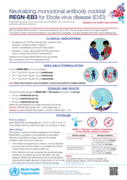
Guidance for health care workers.
Both the REGN-EB3 and mAb114 are recommended for use in EVD. The two drugs should not be given together. The choice of which monoclonal antibody to use depends on availability, including emerging information about effectiveness.
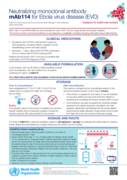
Guidance for health care workers.
Both the REGN-EB3 and mAb114 are recommended for use in EVD. The two drugs should not be given together. The choice of which monoclonal antibody to use depends on availability, including emerging information about effectiveness.
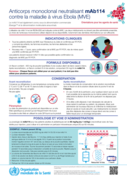
Guidance for health care workers.
Both the REGN-EB3 and mAb114 are recommended for use in EVD. The two drugs should not be given together. The choice of which monoclonal antibody to use depends on availability, including emerging information about effectiveness.
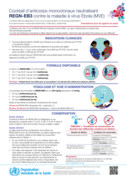
Cocktail d’anticorps monoclonaux neutralisant REGN-EB3 contre la maladie à virus Ebola (MVE)
recommended
Guidance for health care workers.
Both the REGN-EB3 and mAb114 are recommended for use in EVD. The two drugs should not be given together. The choice of which monoclonal antibody to use depends on availability, including emerging information about effectiveness.
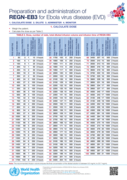
Guidance for health care workers.
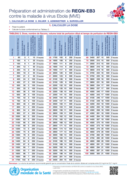
Guidance for health care workers.

The pandemic has emphasized the high risk of avoidable harm to patients, health workers, and the general public, and has identified a range of safety gaps across all core components of health systems at all levels.
The rapid review ‘Implications of the COVID-19 pandemic for patient safety’ ex
...
pinga hat es sich zur Aufgabe gemacht psychologische Beratung einfach verfügbar und erschwinglich für alle zu gestalten.
Nach deiner Registrierung erhältst du Zugang zu einem Chat mit einer Psycholog*in (textbasierte Beratung). Dieser Chat bietet dir einen geschützten Raum, um dich zu deinen T
...
For patients on HFNO with persistent hypoxaemia or respiratory distress:
• Check the equipment: inspect the exterior of the machine, the tubing (circuit), the prong for any sign of mechanical damage, confirm it fits and the filters are in place. Ensure the settings are appropriate and flow is max
...
WHO recommends prompt recognition of progressive acute hypoxaemic respiratory failure when a patient with respiratory distress is failing to respond to standard oxygen therapy and adequate preparation to provide advanced oxygen/ventilatory support.
Hypoxaemic respiratory failure in ARDS commonly re
...
Management of critical COVID-19: Acute hypoxaemic respiratory failure and COVID-19: Recognize ARDS
recommended
WHO recommends prompt recognition of progressive acute hypoxaemic respiratory failure when a patient with respiratory distress is failing to respond to standard oxygen therapy and adequate preparation to provide advanced oxygen/ventilatory support.
Hypoxaemic respiratory failure in ARDS commonly
...
For patients on NIPPV or HFNO with persistent hypoxaemia or respiratory distress:
• Check the equipment: inspect the exterior of the machine, the tubing (circuit), the mask for any sign of mechanical damage, confirm it fits securely without leak (if CPAP/BiPAP) and the filters are in place. Ensur
...
