
Filter
472
Featured
60
Language
Document type
162
78
61
42
34
28
23
16
12
10
3
3
Countries
45
39
31
30
20
17
16
16
13
12
12
12
9
9
7
6
6
6
6
5
5
5
5
4
4
4
4
4
4
4
4
4
4
4
3
3
3
3
3
3
3
3
3
3
3
3
3
3
3
2
2
2
2
2
2
2
2
2
2
2
1
1
1
1
1
1
1
1
1
1
1
1
1
1
1
1
1
1
1
1
1
1
1
1
1
1
1
1
1
1
1
1
1
1
1
1
1
1
1
1
1
1
1
1
Authors & Publishers
Publication Years
Category
194
15
14
9
5
3
Corona Crash Course Unit 2: Infection and Spread
recommended
This unit discusses the factors and determinants associated with the spread of Coronavirus
Jesuit Worldwide Learning invites you to learn facts and test your knowledge on the ongoing pandemic caused by Coronavirus (COVID 19) through a fun-interactive crash course! Access is free! You have only to s
...
In the context of health, stigma is the negative association between a person or group of people who share certain characteristics and a specific disease. In an outbreak, this may mean people are labeled, stereotyped, discriminated against, treated separately, and/or experience loss of status becaus
...
Pandemics and outbreaks have differential impacts on women and men. From risk of exposure and biological susceptibility to infection to the social and economic implications, individuals’ experiences are likely to vary according to their biological and gender characteristics and
...

Deeply concerned by the morbidity and mortality caused by the COVID-19 pandemic, the negative impacts on physical and mental health and social well-being, the negative impacts on economies and societies and the consequent exacerbation of inequalities within and between countries.
...
Une liste de 40 questions clés visant à aider les gouvernements à veiller au respect des droits humains dans leurs réponses à la pandémie
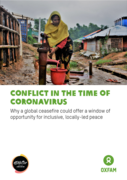
The equation is simple: we cannot effectively respond to a global pandemic when millions of people are still caught in warzones. We cannot treat sick people when hospitals are being bombed, or prevent the spread of coronavirus when tens of millions are forced to flee from violence. We must have a gl
...
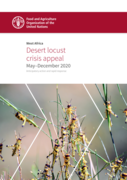
Recent forecasts by the Food and Agriculture Organization of the United Nations (FAO) have indicated a risk of locust invasion in West Africa from June 2020. From East Africa, some swarms could reach the eastern part of the Sahel and continue westwards from Chad to Mauritania.
Surveillance and co
...
Nos enfrentamos a la mayor desaceleración económica de la que se tenga memoria. El sistema humanitario se está preparando para un drástico aumento de los conflictos, la inseguridad alimentaria y la pobreza a medida que las economías se contraen y desaparecen los ingresos por exportaciones, las
...
La pandémie du COVID-19 nous fait tous souffrir. Mais ses effets les plus dévastateurs et les plus déstabilisants se feront ressentir dans les pays les plus pauvres du monde. Nous sommes confrontés au plus important ralentissement économique que nous ayons connu de mémoire d’homme. Le systè
...

While the full effects of COVID-19 remain unknown, the pandemic continues to profoundly impact regional migration and mobility dynamics, with deep health, social and economic consequences for the most vulnerable, including migrants, displaced populations and their host communities, and returnees.
It is too early to know the full impact of COVID-19 on Africa. To date the experience has been varied. There are causes for concern, but also reasons for hope. Early estimates were pessimistic regarding the pandemic’s impact on the continent. But the relatively low numbers of COVID-19 cases report
...
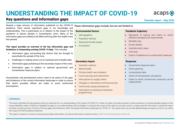
This report provides an overview of the key information gaps and limitations in interpreting existing COVID-19 data
Dans ce rapport, le Partnership for Evidence-Based Response to COVID-19 (PERC), un consortium d’organisations mondiales de santé publique et d’entreprises privées, fait la synthèse des résultats d’une enquête conduite du 29 mars au 17 avril 2020 dans 28 villes des États Membres de l’UA
...
UN human rights experts today called on States to protect the rights of migrants and their families, regardless of their migration status, during and after the COVID-19 pandemic.
This document updates the earlier version published in April 2020. In recent weeks, information on the potential use of chloroquine or hydroxychloroquine for the treatment of people with COVID-19 has been disseminated in academic journals and public media. Although there are now ongoing clinical tri
...
Corona Crash Course. App Version for Offline Use
recommended
A new virus, called the Coronavirus emerged in December 2019 and has spread to people around the world.
Jesuit Worldwide Learning invites you to learn facts and test your knowledge on the ongoing pandemic caused by Coronavirus (COVID 19) through a fun-interactive crash course!
Access is free! You
...
Scientific Brief, 30 June 2020
In March 2020 the World Health Organization (WHO) declared the outbreak of a novel coronavirus disease, COVID-19, to be a pandemic, due to the speed and scale of transmission.
WHO and public health authorities around the world are taking action to contain the COVID-19 outbreak. Certain populations,
...
Les gouvernements du monde entier mettent rapidement en œuvre des mesures pour contenir la propagation de COVID-19 et protéger leurs citoyens. De nombreux gouvernements mettent en place des centres de quarantaine et leurs forces armées sont souvent mobilisées pour les gérer. Certains pays const
...
Los gobiernos de todo el mundo están aplicando rápidamente medidas para contener la propagación de COVID-19 y proteger a sus ciudadanos. Muchos gobiernos están estableciendo centros de cuarentena y sus fuerzas armadas suelen movilizarse para gestionarlos. Algunos países están construyendo camp
...
