
Filter
33
Featured
6
5
Language
Document type
20
5
4
2
1
1
Countries
8
1
1
1
1
1
1
Authors & Publishers
Publication Years
Category
2
1

As the United Nations’ public health agency, WHO has an important role to play in the global public health response to events involving the possible deliberate use of biological and chemical hazards against a human population.
This manual describes methods for investigating clusters or outbreaks that may be of chemical origin and describes the importance of a structured, coordinated, collaborative multidisciplinary, multi-agency approach at local, regional, national and international levels.

Almost 25% of deaths worldwide could be prevented if the actions in the compendium were fully implemented
This compendium provides a systematic compilation of published guidance from WHO and other UN organizations on health and environment. Guidance on policies and actions as well as awareness rais
...
2nd edition. The purpose of the WHO human health risk assessment toolkit: chemical hazards is to provide its users with guidance to identify, acquire and use the information needed to assess chemical hazards, exposures and the corresponding health risks in their given health risk assessment contexts
...
The GHS Index is intended to be a key resource in the face of increasing risks of high-consequence and globally catastrophic biological events and in light of major gaps in international financing for preparedness. These risks are magnified by a rapidly changing and interconnected world; increasing
...
Crisis Emergency Risk Communication. Manual
recommended
The CERC manual provides an evidence-based framework and recommended practices for anyone who communicates on behalf of an organization responding to major emergencies such as natural disasters.
Communication Risk in Public Health Emergencies
recommended
A WHO Guideline for Emergency Risk Communication (ERC) policy and practice.
Recent public health emergencies, such as the Ebola virus disease outbreak in West Africa (2014–2015), the emergence of the Zika virus syndrome in 2015–2016 and multi-country yellow fever outbreaks in Africa in 2016, h
...
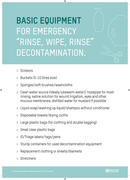
Arabic version available: http://www.who.int/environmental_health_emergencies/deliberate_events/decontamination_poster_ar.pdf
The document is a practical guide on how to prepare for and respond to emergencies and disasters. It explains that disasters such as floods, fires, severe weather, or power outages can happen at any time and that individuals should be prepared in advance. The guide provides advice on personal prepar
...
La communication sur les risques est un aspect à part entière des interventions d’urgence. Il s’agit de l’échange en temps réel d’informations, de conseils et d’avis entre les experts, les responsables communautaires, les décideurs politiques et les populations en situation de risque.
...
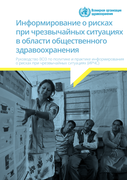
Руководство ВОЗ по политике и практике информирования о рисках при чрезвычайных ситуациях (ИРЧС)
A chemical release may not always be immediately apparent given the fact that many agents are odourless and colourless, and some cause no immediately noticeable effects or symptoms. Be alert to the possible presence of a chemical.
Arabic version available: http://www.who.int/environmental_health_e
...

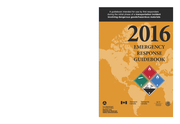
A guidebook intended for use by first responders
during the initial phase of a transportation incident
involving dangerous goods/hazardous materials
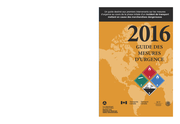
Un guide destiné aux premiers intervenants sur les mesures
d’urgence au cours de la phase initiale d’un incident de transport
mettant en cause des marchandises dangereuses
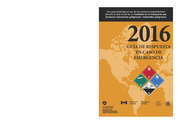
Una guía destinada al uso de los primeros respondedores
durante la fase inicial de un incidente en el transporte que
involucre mercancías peligrosas / materiales peligrosos
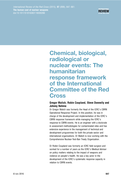
Mounting an effective international humanitarian response to a chemical, biological, radiological or nuclear (CBRN) event, especially if the response is undertaken on an ad hoc basis, would be extremely difficult and would pose many risks to the responders. The International Committee of the Red Cro
...
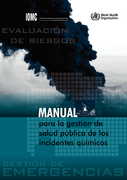
"La finalidad del presente MANUAL DE LA OMS PARA LA GESTIÓN DE SALUD PÚBLICA DE LOS INCIDENTES QUÍMICOS es proporcionar una panorámica general de los principios y funciones de la salud pública en materia de gestión de incidentes y emergencias químicos. Aunque se brinda información para cada
...
