Filter
417
Featured
88
53
Language
Document type
105
63
42
40
32
31
25
21
21
14
14
7
2
Countries
15
10
10
8
6
6
6
6
5
5
5
4
4
4
3
3
3
3
3
2
2
2
2
2
2
2
1
1
1
1
1
1
1
1
1
1
Authors & Publishers
Publication Years
Category
110
76
28
26
21
16
4
With the increase in frequency of disasters, there is a need to improve early warning systems (EWS) for EA to reduce the risks faced by children and their families. As a consequence, the term early warning, early action (EWEA) has become increasingly common among those responding to slow-onset disas
...
Updated with information on Ebola virus disease and Middle East respiratory syndrome coronavirus
A wide variety of health events ranging in severity may occur related to air transport, requiring different responses or, perhaps, no response at all. The target audience for this guidance document incl
...
Règlement sanitaire international (2005)
recommended
La troisième édition du RSI intègre les amendements à l’annexe 7 qui ont été adoptés par la Soixante-Septième Assemblée mondiale de la Santé, par la résolution WHA67.13 (2014). Aux termes de l’annexe 7 modifiée, la durée de la protection conférée par l’administration d’un vacc
...
Reglamento sanitario international (2005)
recommended
En la tercera edición del RSI se recogen las enmiendas al anexo 7 adoptadas por la 67.ª Asamblea Mundial de la Salud en virtud de la resolución WHA67.13 (2014). Con arreglo al anexo 7, en su versión enmendada, la protección contra la fiebre amarilla conferida por la administración de una vacun
...

The checklist is based on efforts by various national and international institutions, including WHO, CDC and UN OCHA. It
identifies 10 key components and tasks for both countries and the international community. This tool establishes timelines
within which to complete tasks of 30, 60 and 90 days r
...
The Guide has been developed to enhance the knowledge capabilities of NDMAs and their local partners. This is accomplished by exposing them to the existing tools and services developed by the international community to facilitate effective disaster response to any scale of disaster (small, medium an
...
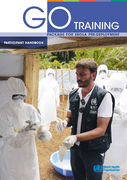
GO pre-deployment training: participant handbook
recommended
This is a pre-deployment training, tailored specially to the Ebola outbreak in West Africa, offered to WHO personnel, consultants, and key partners. The material covered in modules 1-4 is applicable and useful to frontline response workers, national and international. Only Module 5, which focuses on
...
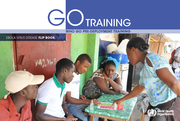
The flip book is for pre-deployment trainings for Ebola response, and is based on frequently asked questions about Ebola virus disease (EVD):
What is Ebola virus disease?
How do people become infected with EVD?
Why WHO is focusing on safe and dignified burials of people who have died
...
All personnel deployed by the World Health Organization (WHO) to any type of public health or humanitarian emergency need to have basic knowledge and skills to perform effectively and safely. That is why it is essential to be trained prior to deployment. GO training is a comprehensive package of mod
...
Crisis and Emergency Risk Communication is an approach to communicating effectively during emergencies. These principles are used by public health professionals and public information officers to provide information that helps individuals, stakeholders, and entire communities make the best possible
...
Planning and preparedness are the keys to dealing effectively with threats that include infectious diseases caused by SARS and the Middle East Respiratory Syndrome or MERS, novel influenza viruses like H1N1, and Ebola. During outbreaks or epidemics of these emerging infectious diseases, healthcare f
...
In January 2007, UNSIC together with OCHA, UNDP and other UN agencies created PIC (Pandemic Influenza Contingency) to focus on mitigating impacts of the next influenza pandemic and develop greater readiness of the UN System, national governments and the humanitarian community
The Communicable Diseases Policy Research Group (CDPRG) is a multidisciplinary team within the Department of Global Health & Development in the Faculty of Public Health and Policy at the London School of Hygiene & Tropical Medicine.The Group is based in Bangkok, Thailand, and conducts research acros
...
The Joint FAO-WHO-WOAH Global Early Warning System (GLEWS+) for health
threats and emerging risks at the human-animal-ecosystem interface
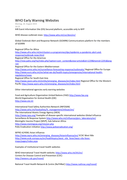
Early Warning Websites Linklist
recommended
Linklist