
Filter
2762
Filtered Results: 2762
Text search:
The
Psychosocial
Working
Group
Featured
Recommendations
290
New Publications
700
Language
Document type
No document type
1651
Studies & Reports
386
Guidelines
299
Manuals
168
Strategic & Response Plan
124
Training Material
48
Situation Updates
41
Fact sheets
32
Resource Platforms
7
Brochures
3
Online Courses
2
Infographics
1
Countries / Regions
Global
101
India
96
Kenya
89
Syria
84
Liberia
62
Western and Central Europe
58
Sierra Leone
57
South Africa
56
Bangladesh
55
Myanmar / Burma
55
Uganda
51
Ethiopia
47
Ukraine
46
Nigeria
46
Nepal
42
Zambia
42
Congo, Democratic Republic of
41
South Sudan
37
Malawi
36
Africa
36
Rwanda
34
Latin America and the Carribbean
30
Namibia
28
Ghana
27
Mozambique
27
Tanzania
27
Eastern Europe
27
Philippines
23
Guinea
21
Zimbabwe
20
Haiti
17
Lebanon
17
Venezuela
16
Jordan
15
Asia
14
Germany
14
Yemen
14
Indonesia
14
Lesotho
13
Afghanistan
12
South–East Asia Region
12
West and Central Africa
11
East and Southern Africa
11
Central African Republic
11
Botswana
11
Pakistan
11
Middle East and North Africa
10
Cambodia
9
Russia
9
Colombia
8
Senegal
8
Sudan
8
Georgia
8
Somalia
8
Turkey
7
Burkina Faso
7
Eastern Europe and Central Asia
7
Vietnam
7
Brazil
7
Sri Lanka
7
Iraq
7
Eswatini/ Swaziland
7
Cameroon
6
Albania
6
Burundi
6
Moldova
6
Tajikistan
5
Laos
5
Peru
5
Palestine
5
Benin
4
Papua New Guinea
4
Mali
4
Thailand
3
Iran
3
Canada
3
USA
3
Guinea-Bissau
3
Angola
3
North Macedonia
2
Mexico
2
Serbia
2
Gambia
2
Togo
2
China
2
Kazakhstan
2
Chile
2
Estonia
2
Kyrgyzstan
2
Niger
2
Malaysia
2
Armenia
2
Croatia
2
Hungary
2
Lithuania
2
Western Pacific Region
2
Turkmenistan
2
Jamaica
2
United Kingdom
2
Belarus
2
Southern Africa
2
Côte d’Ivoire / Ivory Coast
2
Egypt
2
Romania
2
Greece
2
Madagascar
2
El Salvador
1
Fiji
1
Singapore
1
Bulgaria
1
Mauritania
1
Ireland
1
Paraguay
1
Japan
1
Belgium
1
Mauritius
1
Portugal
1
Spain
1
Azerbaijan
1
Bosnia and Herzegovina
1
Poland
1
Chad
1
Libya
1
Bhutan
1
Ecuador
1
Guatemala
1
Authors & Publishers
Publication Years
Category
Countries
947
Key Resources
194
Women & Child Health
160
Clinical Guidelines
129
Public Health
112
Capacity Building
82
Pharmacy & Technologies
4
Annual Report MEDBOX
2
Toolboxes
Mental Health
486
COVID-19
246
HIV
245
Disability
198
Conflict
178
Refugee
104
Ebola & Marburg
97
TB
83
Caregiver
80
Natural Hazards
66
Planetary Health
37
Rapid Response
36
Global Health Education
29
NCDs
27
NTDs
22
2.0 Rapid Response
20
Social Ethics
14
Specific Hazards
10
Zika
9
Pharmacy
7
AMR
6
Health Financing Toolbox
5
Polio
4
Typhoon
3
South Sudan
1
Cholera
1
Malaria
1
A report submitted to the International Labour Organization, Geneva
This regional technical guidance note was developed for the UNFPA Asia-Pacific Regional Office (APRO) and Asia-Pacific Country Offices to provide guidance on older persons, health workers, and caregivers in the contexts of COVID-19 to effectively support each member state and work with other partner...
Including a Tool to Assess the Adolescent Health and Development Component in Pre-Service Education of Health-Care Providers
Increasing the Odds: A Series to Understanding Gambling Disorders. Vol.7
All editions of Increasing the Odd sare available as a free download at https://www.icrg.org/resources/monographs

This report presents the findings from a ‘deep dive’ undertaken by UNICEF East Asia and the Pacific Regional Office to consider the experiences in Cambodia, Indonesia, the Lao People’s Democratic Republic, Malaysia, Myanmar, the Philippines and the Pacific. The target audience for this report ...

At the end of 2023, WHO convened our first-ever annual WHO Stakeholder Review Conference for Prevention and Response to Sexual Misconduct. Aimed at joint learning and frank discussion on challenges faced in the achieving zero tolerance for all forms of sexual misconduct by aid workers, the Conferenc...

Despite the continuing war in Ukraine, the Government is preparing for the country’s recovery and reconstruction. Given the magnitude of the attacks on the health infrastructure and consequent disruption to health system functioning, reconstruction of the health system is integral to the countryâ€...

This handbook is a quick-reference tool that provides practical, field-level guidance to establish and maintain a GBV sub-cluster in a humanitarian emergency. It provides the foundations for coordination. More in-depth information can be pursued through resources referenced in this handbook. The GBV...
School health programmes are the most cost-effective way to influence health behaviours in young people. The purpose of this two-part handbook is to support schools as they seek to implement interventions in order to reduce the main modifiable risk behaviours for noncommunicable disea...
This training module is meant to strengthen the capacity of CHVs to prevent the Non Communicable Diseases at the community level . The Government of Kenya is committed to supporting community health initiatives and accelerating the achievement of the KHSS&IP goals, Millennium Development G...

Updated version – September 2020
The COVID-19 pandemic is affecting everyone. Globally, millions of people have been infected with the virus, while hundreds of thousands have lost their lives. In Moldova, the pandemic is placing an ever-increasing pressure on the health care and social protectio...
What can you expect?
As a future facilitator your role will be to learn about the structure of mhGAP-IG, how to teach the materials and utilize opportunities to prastice facilitation and supervision skills.
As a supervisor your role will be to serve as a point of reference for non-specialized heal...

Mental health problems are common and cause great suffering to individuals and communities around the world. They have a significant impact not only on the physical and mental health of those affected but also on their families and the communities they live in. At the same time, all communities have...
Report by the Director-General 22 May 2022

Strengthening global health security to protect the world against future epidemics and pandemics requires well-tested and decentralized capacities for the local detection and rapid containment of outbreaks of infectious disease. For such capacities to translate into effective response actions, ind...

Building on the WHO guidelines for disclosure to children up to age 12 in 2011, this implementation guidance provides evidence on existing interventions that support children and adolescents living with HIV in the process of disclosure. It includes interventions that focuses on safe disclosure, as w...
Evaluating the Return on Investment of Scaling Up Treatment for Depression, Anxiety, and Psychosis
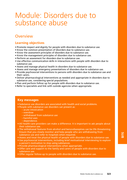
Module: Disorders due to substance abuse mhGAP
recommended
Accessed: 21.03.2019
mhGAP Training Manual for the mhGAP Intervention Guide for mental, neurological and substance use disorders in non-specialized health settings – version 2.0 (for field testing)
