
Filter
2830
Filtered Results: 2830
Text search:
healthy
workforce
Featured
Recommendations
248
New Publications
677
Language
Document type
No document type
1278
Studies & Reports
629
Guidelines
362
Strategic & Response Plan
216
Manuals
185
Fact sheets
63
Training Material
42
Situation Updates
26
Resource Platforms
15
Infographics
7
Brochures
5
Dashboards/Maps
1
App
1
Countries / Regions
Global
179
Kenya
111
India
79
Sierra Leone
75
Liberia
70
Ethiopia
67
Western and Central Europe
60
Rwanda
55
Africa
54
Nigeria
53
Malawi
51
South Africa
49
Uganda
48
Namibia
46
Myanmar / Burma
46
Nepal
44
Syria
41
Bangladesh
41
Zambia
39
Latin America and the Carribbean
35
Ghana
32
Tanzania
31
South–East Asia Region
30
Ukraine
27
East and Southern Africa
25
Lesotho
24
West and Central Africa
24
Guinea
23
Congo, Democratic Republic of
22
Eastern Europe
20
Philippines
17
Botswana
17
Indonesia
17
Asia
16
Middle East and North Africa
15
Haiti
14
Cambodia
14
Eastern Europe and Central Asia
14
Brazil
14
Yemen
14
Senegal
13
Afghanistan
13
Zimbabwe
12
Russia
12
South Sudan
12
Pakistan
12
Cameroon
11
Mozambique
11
Peru
8
Somalia
8
Thailand
7
Venezuela
7
Western Pacific Region
7
Lebanon
7
Turkey
6
Laos
6
Burkina Faso
6
Jordan
6
Sudan
6
Iraq
6
Moldova
5
Sri Lanka
5
Central African Republic
5
Eswatini/ Swaziland
5
Iran
4
USA
4
Colombia
3
Timor Leste/ East Timor
3
Mexico
3
Benin
3
Gambia
3
China
3
Chile
3
Burundi
3
Germany
3
Southern Africa
3
Vietnam
3
Papua New Guinea
3
Palestine
3
Mali
3
Ecuador
3
North Macedonia
2
El Salvador
2
Togo
2
Qatar
2
Bulgaria
2
Paraguay
2
Jamaica
2
Mauritius
2
United Kingdom
2
Bolivia
2
Egypt
2
Chad
2
Libya
2
Tajikistan
1
Switzerland
1
Kazakhstan
1
Albania
1
Kyrgyzstan
1
Niger
1
Malaysia
1
Dominican Republic
1
Guinea-Bissau
1
Hungary
1
Lithuania
1
Saudi Arabia
1
North America
1
Maldives
1
South Korea
1
Côte d’Ivoire / Ivory Coast
1
Belize
1
Costa Rica
1
Guyana
1
Panama
1
Argentina
1
Nicaragua
1
Djibouti
1
Romania
1
Slovakia
1
Poland
1
Honduras
1
Angola
1
Bhutan
1
Guatemala
1
Authors & Publishers
Publication Years
Category
Countries
1167
Public Health
217
Clinical Guidelines
152
Women & Child Health
136
Key Resources
135
Capacity Building
48
Pharmacy & Technologies
20
Annual Report MEDBOX
1
Toolboxes
COVID-19
348
Mental Health
201
Caregiver
146
HIV
129
Planetary Health
114
Disability
106
TB
83
Conflict
80
Global Health Education
80
Ebola & Marburg
75
NCDs
65
Health Financing Toolbox
60
AMR
58
Rapid Response
54
2.0 Rapid Response
48
NTDs
42
Refugee
38
Natural Hazards
36
Malaria
35
Pharmacy
28
Polio
16
Social Ethics
9
Zika
9
Specific Hazards
8
Cholera
6
Typhoon
1
Updated guidance. The guidance provides useful information to staff working in prisons, as well as to health and prison authorities, explaining how to prevent and address a potential outbreak of COVID-19. In addition, it aims to protect the health and well-being of all those who live and work in, an...
Midwifery Capacity Building Strategy for Northern Syria
2017-2021
Available in Arabic
The document is a summary report by the World Health Organization (WHO) Regional Office for the Eastern Mediterranean, focusing on a capacity-building workshop held in Abu Dhabi in 2019. The workshop addressed the management and care of substance use disorders, aiming to improve technical and manage...

Non-Communicable Diseases (NCDs), including mental disorders, currently pose one of the biggest threats to health and development globally, particularly in low and middle income countries2. It is predicted that unless proven interventions are rapidly implemented in countries, in the short to medium ...
The Strategic Advisory Group of Experts (SAGE) on Immunization held a meeting on 3-6 October 2022. This report summarizes the discussions, conclusions and recommendations.
It covers the following items:
Global Reports
Immunization Agenda 2030 and Regional reports
Monkeypox
RSV
COVID-19 vacci...
The recommendations cover the level of blood pressure to start medication, what type of medicine or combination of medicines to use, the target blood pressure level, and how often to have follow-up checks on blood pressure. In addition, the guideline provides the basis for how physicians and other h...

Promoting health and preventing disease is a critical component of the effort required to achieve Universal Health Coverage (UHC). to date, efforts to achieve UHC have focused mostly on strengthening health systems and their capacities to provide curative care. However, experience from the COVID-19 ...


Addressing comorbidities and risk factors for TB is a crucial component of Pillar one of the End TB Strategy, which focuses on integrated patient-centred care and prevention, including action on TB and comorbidities. The Framework for collaborative action on TB and comorbidities aims to support coun...

WHO’s Ambition and Action in Nutrition 2016-2025 is anchored in the six global targets for improving maternal, infant and young child nutrition and the global diet-related NCD targets.
In support of the 2030 Agenda for Sustainable Development, particularly SDG2 and SDG3, and in concert w...
In support of the 2030 Agenda for Sustainable Development, particularly SDG2 and SDG3, and in concert w...
The current SEARVAP (South-East Asia regional vaccine action plan) describes a set of regional goals and objectives for immunization and control of vaccine-preventable diseases for 2016 – 2020 and highlights priority actions, targets and indicators that address the specific needs and challenges of...
The ICOPE Implementation Framework provides a score card to help assess the overall capacity of health and social care services and systems to deliver integrated care in community settings and support the development of ICOPE implementation action plans. There are 19 actions needed to implement ICOP...
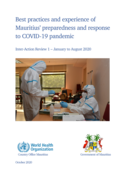
his Inter Action Review report for the COVID-19 outbreak in Mauritius documents and assesses the country’s capacity to respond to the outbreak and identifies the best practices, strengths, gaps and challenges of the national response. Areas requiring improvements or sustained actions have been ide...

Noma (cancrum oris) is a severe gangrenous disease of the mouth and face. It mostly affects children between the ages of 2 and 6 years living in extreme poverty. In addition to the known factors such as malnutrition, lack of vaccination in children and poor oral hygiene, several social and environme...

Saving lives is the priority of WHO’s response in Ukraine. WHO works to ensure time-critical, lifesaving multisectoral assistance, non-discriminatory access to emergency and essential health services and priority prevention programmes, and laying the foundation for longer-term health systems recov...

In the last decade, Timor-Leste has made remarkable progress in strengthening its health system and improving the health status of its population. This has resulted in an increased life expectancy, and the achievement of Millennium Development Goals such as a reduction in infant and under-five morta...

The South African WHO Country Cooperation Strategy (CCS) 2023–2027 focuses on four key strategic priorities based on the country’s health needs and disease epidemiology, while also considering the need for building resilient health systems for UHC and health security in the post pandemic period....

Despite being a curable and preventable disease, tuberculosis (TB) remains as one of the major challenges for health systems, globally. Every year, TB affects more than 10 million people and kills more than 1.4 million people. WHO’s Digital Health for the End TB Strategy – an Agenda for Action o...
