
Filter
2761
Filtered Results: 2761
Text search:
The
Psychosocial
Working
Group
Featured
Recommendations
290
New Publications
700
Language
Document type
No document type
1651
Studies & Reports
386
Guidelines
298
Manuals
168
Strategic & Response Plan
124
Training Material
48
Situation Updates
41
Fact sheets
32
Resource Platforms
7
Brochures
3
Online Courses
2
Infographics
1
Countries / Regions
Global
101
India
96
Kenya
89
Syria
84
Liberia
62
Western and Central Europe
58
Sierra Leone
57
South Africa
56
Bangladesh
55
Myanmar / Burma
55
Uganda
51
Ethiopia
47
Ukraine
46
Nigeria
46
Nepal
42
Zambia
42
Congo, Democratic Republic of
41
South Sudan
37
Malawi
36
Africa
36
Rwanda
34
Latin America and the Carribbean
30
Namibia
28
Ghana
27
Mozambique
27
Tanzania
27
Eastern Europe
27
Philippines
23
Guinea
21
Zimbabwe
20
Haiti
17
Lebanon
17
Venezuela
16
Jordan
15
Asia
14
Germany
14
Yemen
14
Indonesia
14
Lesotho
13
Afghanistan
12
South–East Asia Region
12
West and Central Africa
11
East and Southern Africa
11
Central African Republic
11
Botswana
11
Pakistan
11
Middle East and North Africa
10
Cambodia
9
Russia
9
Colombia
8
Senegal
8
Sudan
8
Georgia
8
Somalia
8
Turkey
7
Burkina Faso
7
Eastern Europe and Central Asia
7
Vietnam
7
Brazil
7
Sri Lanka
7
Iraq
7
Eswatini/ Swaziland
7
Cameroon
6
Albania
6
Burundi
6
Moldova
6
Tajikistan
5
Laos
5
Peru
5
Palestine
5
Benin
4
Papua New Guinea
4
Mali
4
Thailand
3
Iran
3
Canada
3
USA
3
Guinea-Bissau
3
Angola
3
North Macedonia
2
Mexico
2
Serbia
2
Gambia
2
Togo
2
China
2
Kazakhstan
2
Chile
2
Estonia
2
Kyrgyzstan
2
Niger
2
Malaysia
2
Armenia
2
Croatia
2
Hungary
2
Lithuania
2
Western Pacific Region
2
Turkmenistan
2
Jamaica
2
United Kingdom
2
Belarus
2
Southern Africa
2
Côte d’Ivoire / Ivory Coast
2
Egypt
2
Romania
2
Greece
2
Madagascar
2
El Salvador
1
Fiji
1
Singapore
1
Bulgaria
1
Mauritania
1
Ireland
1
Paraguay
1
Japan
1
Belgium
1
Mauritius
1
Portugal
1
Spain
1
Azerbaijan
1
Bosnia and Herzegovina
1
Poland
1
Chad
1
Libya
1
Bhutan
1
Ecuador
1
Guatemala
1
Authors & Publishers
Publication Years
Category
Countries
947
Key Resources
194
Women & Child Health
160
Clinical Guidelines
129
Public Health
112
Capacity Building
82
Pharmacy & Technologies
4
Annual Report MEDBOX
2
Toolboxes
Mental Health
486
COVID-19
246
HIV
244
Disability
198
Conflict
178
Refugee
104
Ebola & Marburg
97
TB
83
Caregiver
80
Natural Hazards
66
Planetary Health
37
Rapid Response
36
Global Health Education
29
NCDs
27
NTDs
22
2.0 Rapid Response
20
Social Ethics
14
Specific Hazards
10
Zika
9
Pharmacy
7
AMR
6
Health Financing Toolbox
4
Polio
4
Typhoon
3
South Sudan
1
Cholera
1
Malaria
1
The toolkit aims to provide researchers with guidance for improving the quality of studies that use administrative data to better ascertain child maltreatment incidence, response and service delivery. However, these are complex studies to conduct, and the toolkit is not meant to be comprehensive. Re...
The Advancing Climate-Resilient Education Technical Guidance builds on the USAID 2022–2030 Climate Strategy and the 2018 USAID Education Policy to support USAID Missions and partners who seek to integrate climate action and awareness into education programs and are committed to achieving climate-r...
This report documents the secondary humanitarian problems and impacts of large-scale Ebola outbreak on the different humanitarian sectors, to provide a non-exhaustive plan to help future responders. A large scale Ebola outbreak, in this document, refers to an epidemic with an unprecedented scale, ge...

UNHCR’s Public Health Strategy 2021-2025 is based on the lessons learnt, and builds on the achievements, of the Global Strategy for Public Health 2014-2018.
Progress was made on policies favouring inclusion and integration into national systems3 with 92% of 48 operations surveyed reporting refuge...
The resources provide both the older as well as the updated Operational Guidelines for antiretroviral therapy centres, including administrative issues, functions and establishment of centres, reporting and recording tools, measures to improve retention in HIV care, supply chain management of drugs a...
The purpose of this Operational Guideline is to support state health authorities, programme managers and health care professionals with recommendations on appropriate management of children with SAM in the health facilities. Facility based management includes setting up and managing within the healt...
The purpose of cancer screening tests is to detect pre-cancer or early-stage cancer in asymptomatic individuals so that timely diagnosis and early treatment can be offered, where this treatment can lead to better outcomes for some people.
The aim of a cancer screening programme is either to reduc...
The Feedback Starter-Kit responds to key questions ( ) and provides the most important tips ( ) for setting up and running a simple feedback mechanism. At the end of this document there is an overview of the templates needed to plan the mechanism and collect, answer, analyse and share community feed...

Despite the existence of criminal law, which is an important aspect of anti-FGM policies and programmes, there is not much research on the effects of cross-border practices that invalidate the law as a deterrent. Much remains unknown about the practice of cross-border FGM, specifically about gaps in...
The standard operating procedures (SOP) for referral care cover all the refugee populations living in Lebanon. These SOPs outline the policies and procedures for referral care in Lebanon, including the limits in health assistance that can be provided.

To contribute to the availability of basic knowledge and skills for the provision of palliative care in
the African region, the African Palliative Care Association (APCA) has developed a competencybased core curriculum framework for use in introductory training on palliative care. The curriculum ...
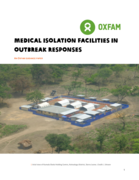
This technical briefing paper details the construction and setup of medical isolation facilities in support of infectious disease outbreak responses.
The guide aims to provide health and DRM practitioners, planners and policymakers across sectors with targeted information to help them strengthen national health systems and integrate the risks of disease outbreaks in national DRR strategies
The following are some of the principles and approache...

The Contingency Fund for Emergencies (CFE) provides WHO with rapid and flexible resources to respond to disease outbreaks and other health emergencies. The annual report provides an overview of the use and impact of the Fund over the previous year.

This Global Competency Standards sets the benchmark for the health workforce in providing equality of care to refugees and migrants. Refugee and migrant populations are highly diverse, with significant variation in life experiences, health needs and access to health care. The standards described out...
Integrating WASH and MHCP interventions will always require imagination and creativity to adapt the approach to specific conditions, opportunities and constraints in each context. The book is designed to stimulate reflection and encourage initiatives to seek opportunities for closer integration of t...
This document provides information for WHO Member States, particularly low-income and middle-income countries, to strengthen preparedness and response plans with regard to the social and mental health consequences of biological and chemical attacks.
Child friendly spaces (CFS) are safe spaces where
communities create nurturing environments in which
children can access free and structured play and
learning activities. CFS, also commonly referred to
as Child Centred Spaces or Safe Spaces for Children,
may provide educational and psychosocial...
A summary of the national drug situation
A report submitted to the International Labour Organization, Geneva
