
Filter
2120
Filtered Results: 2120
Text search:
Government
of
the
Republic
of
South
Africa
Featured
Recommendations
156
New Publications
539
Language
Document type
No document type
1139
Studies & Reports
555
Guidelines
163
Strategic & Response Plan
101
Manuals
97
Fact sheets
23
Situation Updates
21
Training Material
13
Resource Platforms
4
Infographics
3
App
1
Countries / Regions
Global
154
South Africa
101
Africa
75
Kenya
67
Nigeria
62
Uganda
60
Congo, Democratic Republic of
57
Ethiopia
57
Liberia
52
South Sudan
44
Sierra Leone
43
Rwanda
42
Zambia
41
Namibia
40
Tanzania
38
Malawi
33
Ghana
28
Syria
26
East and Southern Africa
25
West and Central Africa
24
Mozambique
22
Asia
22
Central African Republic
22
Guinea
20
Lesotho
19
Bangladesh
18
Western and Central Europe
17
India
17
Myanmar / Burma
17
Cameroon
15
Yemen
15
Latin America and the Carribbean
14
Zimbabwe
13
Senegal
12
Botswana
12
Middle East and North Africa
11
South–East Asia Region
11
Afghanistan
10
Sudan
10
Philippines
9
Somalia
9
Burkina Faso
8
Mali
8
Nepal
7
Benin
7
Haiti
7
Eastern Europe and Central Asia
7
Indonesia
7
Eswatini/ Swaziland
7
Côte d’Ivoire / Ivory Coast
6
Colombia
5
Ukraine
5
China
5
Burundi
5
Venezuela
5
Angola
5
Iraq
5
Togo
4
Niger
4
Cambodia
4
Western Pacific Region
4
Lebanon
4
Brazil
4
Russia
4
Madagascar
4
Pakistan
4
Thailand
3
Mexico
3
Gambia
3
Iran
3
Guinea-Bissau
3
Jordan
3
Germany
3
Mauritius
3
Southern Africa
3
Vietnam
3
Palestine
3
Chad
3
Albania
2
Gabon
2
Jamaica
2
France
2
Eastern Europe
2
Moldova
2
Sri Lanka
2
Libya
2
North Macedonia
1
Tajikistan
1
North Korea
1
Timor Leste/ East Timor
1
Turkey
1
Kazakhstan
1
Chile
1
Laos
1
Kyrgyzstan
1
Congo-Brazzaville
1
Vanuatu
1
Morocco
1
Mongolia
1
Italy
1
Armenia
1
Turkmenistan
1
Japan
1
Tunisia
1
United Kingdom
1
Portugal
1
Spain
1
Bosnia and Herzegovina
1
Papua New Guinea
1
Djibouti
1
Romania
1
Greece
1
Poland
1
Ecuador
1
Solomon Islands
1
Authors & Publishers
Publication Years
Category
Countries
740
Key Resources
132
Public Health
127
Women & Child Health
122
Clinical Guidelines
102
Capacity Building
24
Pharmacy & Technologies
19
Toolboxes
HIV
216
COVID-19
161
Mental Health
155
TB
101
Planetary Health
100
Disability
86
Conflict
74
Ebola & Marburg
70
Health Financing Toolbox
63
NTDs
60
Global Health Education
60
Refugee
52
Rapid Response
46
Caregiver
42
AMR
41
Pharmacy
26
NCDs
25
Malaria
25
2.0 Rapid Response
25
Natural Hazards
23
Cholera
13
Polio
12
Zika
11
Specific Hazards
7
Social Ethics
4
South Sudan
2
Typhoon
1
Vitamin D deficiency is thought to be common among pregnant women, particularly during the winter months, and has been found to be associated with an increased risk of pre-eclampsia, gestational diabetes mellitus, preterm birth, and other tissue-specific conditions.
This guideline is intended for ...
This document aims to assist policy‑makers, health care providers and researchers to understand key concepts in health ethics and to identify basic ethical questions surrounding health and health care. It illustrates the challenges of applying ethical principles to global public health and outline...
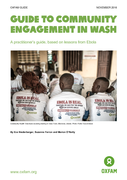
Guide to community engagement in WASH
recommended
A practioner's guide, based on lessons from Ebola.
This guide is a compilation of best practices and key lessons learned through Oxfam’s experience of community engagement during the 2014–15 Ebola response in Sierra Leone and Liberia. It aims to inform public health practitioners and programme ...

OECD Development Policy Tools
Recognising that donor policies and responses constantly evolve, this guidance recommends that donors operating in situations of forced displacement prioritise three broad areas of work, where they can best contribute to existing capacities at the national, regiona...
Recognising that donor policies and responses constantly evolve, this guidance recommends that donors operating in situations of forced displacement prioritise three broad areas of work, where they can best contribute to existing capacities at the national, regiona...

Providing quality, stigma-free services is essential to equitable health care for all and achieving global HIV goals and broader Sustainable Development Goals related to health. Every person has the right to the highest attainable standard of physical and mental health. Countries have a legal obliga...

As countries commit to achieving universal health coverage, it is imperative to ensure that the design and delivery of palliative care services place attention on quality of care, with action needed across all domains of quality health services: effectiveness, safety, people-centredness, timeliness,...
Comprehensive public health action on population ageing is urgently needed. This will require fundamental shifts, not just in the things we do, but in how we think about ageing itself. The World report on ageing and health outlines a framework for action to foster Healthy Ageing built around the new...

In Control. A Practical Handbook for Professionals Working in Health Emergencies Internationally
recommended
In Control imparts knowledge, provokes reflection and triggers curiosity. The first half of the book provides an overview of the organisations, principles, frameworks and themes that every professional deploying to health emergencies should be aware of. The second half of the book provides practical...

Manual for male circumcision under local anaesthesia and HIV prevention services for adolescent boys and men
recommended
This Manual takes into account those lessons to improve and maintain high quality services. It is aligned with updated recommendations on infection prevention and control -- a foundation for all health care services. Voluntary medical male circumcision for HIV prevention programs also afford a uniqu...

This resource was written to support persons who seek to initiate a support group for suicide loss survivors. Suicide bereavement support groups offer a wide range of benefits that can help individuals to navigate the difficult time following a loss. First and foremost, a support group provides a ch...
Pathogen genomic surveillance has become a priority for public health systems in recent years. Genomic sequencing is increasingly being used to characterize pathogens and monitor important public health priorities (e.g. poliovirus, influenza virus, Mycobacterium tuberculosis and Vibrio cholerae, ant...
This document has been developed to support countries to develop and strengthen peer support groups in mental health and related areas. It addresses the provision of peer support groups in the context of health services and the wider community.

Front. Med., 27 November 2020 | https://doi.org/10.3389/fmed.2020.594728. The Checklist included eight actions for implementing rural pathways in LMICs: establishing community needs; policies and partners; exploring existing workers and scope; selecting health workers; education and training; workin...
These guidelines group all recommendations on TB care and support in one document and are complemented by an operational handbook. The guidelines are to be used primarily by national TB programmes, or their equivalents in Ministries of Health, stakeholders and technical organizations working on...

Antibiotics and other antimicrobial agents are invaluable life savers, particularly in resource-limited countries where infectious diseases are abundant. Both uncomplicated and severe infections are potentially curable as long as the aetiological agents are susceptible to the ...

Recently, Sri Lanka has been impacted by multiple natural disasters. Sri Lanka experienced a landslide in October 2014, and flooding in December 2014.8 Sri Lanka withstood the worst drought conditions witnessed in four decades in 2016; the extreme drought conditions extended into 2017 and produced s...

Small drinking-water supplies commonly experience operational, managerial, technical and resourcing challenges that impact their ability to deliver safe and reliable services. The needs and opportunities associated with these supplies therefore warrant explicit consideration in policies and regulati...
This document has been developed to provide training and guidance on how to integrate a human rights approach in mental health and related areas, based on international human rights instruments, in particular the UN Convention on the Rights of Persons with Disabilities (CRPD).
This document has been developed to support countries develop and strengthen individualized peer support services in mental health and related areas. It addresses the provision of individualized peer support in the context of health services and the wider community.
Managing possible serious bacterial infection in young infants when referral is not feasible
recommended
It provides guidance on care for use in resource-limited settings or in settings where families with sick young infants do not accept or cannot access referral care, but can be managed in outpatient settings by an appropriately trained health worker. The guideline seeks to provide programmatic guida...
