
Filter
2243
Filtered Results: 2243
Text search:
Community
Health
Serivces
Division
and
Family
Health
Division
Featured
Recommendations
155
New Publications
698
Language
Document type
No document type
1464
Studies & Reports
333
Guidelines
180
Manuals
133
Strategic & Response Plan
65
Training Material
34
Fact sheets
19
Situation Updates
10
Resource Platforms
4
Brochures
1
Countries / Regions
India
182
Kenya
118
Nepal
101
Bangladesh
77
Global
73
Uganda
62
Liberia
59
Nigeria
53
Rwanda
52
Myanmar / Burma
52
Namibia
43
Western and Central Europe
41
Ghana
40
Ethiopia
40
Malawi
35
Sierra Leone
34
South Africa
32
Zambia
31
Latin America and the Carribbean
29
Tanzania
26
Philippines
25
Africa
23
Congo, Democratic Republic of
23
Lesotho
21
Syria
20
Senegal
19
South–East Asia Region
19
Ukraine
18
Indonesia
18
Eastern Europe
15
Botswana
15
Zimbabwe
14
Asia
14
South Sudan
14
West and Central Africa
12
Pakistan
11
Cambodia
10
East and Southern Africa
10
Vietnam
10
Thailand
9
Cameroon
9
Afghanistan
9
Mozambique
9
Middle East and North Africa
9
Colombia
8
Haiti
8
Western Pacific Region
8
Eastern Europe and Central Asia
8
Yemen
8
Benin
7
Burkina Faso
7
Guinea
7
Venezuela
7
Jordan
7
Laos
6
Mali
6
Somalia
6
China
5
Lebanon
5
Sri Lanka
5
Central African Republic
5
Peru
4
Brazil
4
Sudan
4
Iran
3
Niger
3
USA
3
Russia
3
Bhutan
3
Eswatini/ Swaziland
3
North Macedonia
2
Tajikistan
2
Timor Leste/ East Timor
2
Togo
2
Burundi
2
Malaysia
2
Croatia
2
Germany
2
North America
2
Turkmenistan
2
Jamaica
2
Japan
2
Spain
2
Papua New Guinea
2
Guatemala
2
Mexico
1
Serbia
1
Turkey
1
Gambia
1
Chile
1
Canada
1
Singapore
1
Kyrgyzstan
1
Vanuatu
1
Bulgaria
1
Armenia
1
Dominican Republic
1
Guinea-Bissau
1
Mauritius
1
United Kingdom
1
Portugal
1
Azerbaijan
1
Belarus
1
Bosnia and Herzegovina
1
Southern Africa
1
Côte d’Ivoire / Ivory Coast
1
Bolivia
1
Argentina
1
Moldova
1
Egypt
1
Romania
1
Palestine
1
Poland
1
Angola
1
Libya
1
Ecuador
1
Authors & Publishers
Publication Years
Category
Countries
1119
Women & Child Health
135
Key Resources
127
Clinical Guidelines
106
Public Health
105
Capacity Building
38
Pharmacy & Technologies
6
Toolboxes
Mental Health
195
Disability
130
HIV
115
COVID-19
107
TB
72
Conflict
63
Caregiver
56
Refugee
55
Planetary Health
42
Ebola & Marburg
41
NTDs
40
Global Health Education
40
Rapid Response
33
AMR
32
Natural Hazards
28
Pharmacy
26
NCDs
20
Malaria
18
2.0 Rapid Response
15
Social Ethics
13
Specific Hazards
12
Health Financing Toolbox
12
Zika
12
Polio
12
Cholera
6
Typhoon
1
In the context of the coronavirus disease (COVID-19) pandemic response, WHO identifies young people as a priority target audience with specific concerns, experiences and behaviours. This policy brief provides relevant insights from behavioural evidence and a set of behavioural considerations for tho...

Health care-associated infections (HAIs) affect patients and health systems every day, causing immense suffering, driving higher health-care costs and hampering efforts to achieve high-quality care for all. HAIs are often difficult to treat, are the major driver of antimicrobial resistance (AMR) and...
In 2018 and early 2019, the WHO Regional Office for Europe’s cultural contexts of health and well-being project worked alongside the University of Exeter’s WHO Collaborating Centre on Culture and Health, the Minsk Regional Centre for Psychiatry and Addiction, and the Institute of Mental Health o...
Structural, Non-structural and Functional Indicators
The World Health Organization organized a Consultation of National Leprosy Programme managers, partners and affected persons to discuss the draft Global Leprosy Strategy, 2021--2030. This virtual event took place from 26 to 30 October 2020. It was attended by more than 450 stakeholders. Contribution...

Anopheles stephensi is an invasive mosquito species which has been found spreading across Africa. While this species presents a new challenge for malaria control on the continent, its surveillance and management have been ongoing in Asia for many years. This document aims to summarize key lessons fr...
Purpose of this document: to present eight practical steps that Member States can take at the national and sub-national level to improve WASH in health care facilities

Setting WHO directions

This publication provides guidance for planning country-specific programming to achieve the triple elimination of mother-to-child (or vertical) transmission of HIV, syphilis and hepatitis B virus. It is based on the WHO Triple Elimination Framework, which promotes an integrated, person-centred appro...
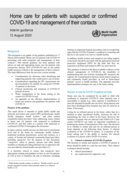
This interim guidance has been updated with advice on safe and appropriate home care for patients with coronavirus disease 2019 (COVID-19) and on the public health measures related to the management of their contacts.

At the end of 2023, WHO convened our first-ever annual WHO Stakeholder Review Conference for Prevention and Response to Sexual Misconduct. Aimed at joint learning and frank discussion on challenges faced in the achieving zero tolerance for all forms of sexual misconduct by aid workers, the Conferenc...
