
Filter
7422
Filtered Results: 7422
Text search:
global
health
education
Featured
Recommendations
557
New Publications
1840
Language
Document type
No document type
3968
Studies & Reports
1477
Guidelines
791
Manuals
387
Strategic & Response Plan
331
Training Material
147
Fact sheets
143
Situation Updates
60
Resource Platforms
40
Infographics
36
Brochures
16
Videos
13
Online Courses
10
App
2
Dashboards/Maps
1
Countries / Regions
Global
434
India
250
Kenya
238
Ethiopia
156
South Africa
147
Uganda
140
Nigeria
138
Sierra Leone
135
Myanmar / Burma
132
Nepal
128
Liberia
121
Western and Central Europe
116
Zambia
116
Africa
115
Malawi
110
Bangladesh
110
Latin America and the Carribbean
109
Rwanda
106
Tanzania
103
Syria
100
Ghana
89
Namibia
80
Ukraine
74
Congo, Democratic Republic of
74
Lesotho
64
Senegal
63
Indonesia
63
Philippines
59
South Sudan
55
Zimbabwe
54
South–East Asia Region
51
Asia
49
Eastern Europe
47
Cambodia
46
Burkina Faso
45
Mozambique
45
Haiti
43
Brazil
39
Guinea
38
East and Southern Africa
36
West and Central Africa
34
Cameroon
32
Yemen
32
Middle East and North Africa
31
Venezuela
27
Russia
27
Botswana
27
Afghanistan
26
Germany
26
Benin
25
Central African Republic
23
Pakistan
23
Colombia
22
Eastern Europe and Central Asia
22
Vietnam
22
Thailand
21
Lebanon
21
Jordan
20
Sudan
20
Madagascar
20
China
19
Eswatini/ Swaziland
19
Mali
16
Laos
15
Chile
14
Sri Lanka
14
Tajikistan
13
Albania
12
Western Pacific Region
12
Moldova
12
Somalia
12
Paraguay
11
Iraq
10
Turkey
9
Côte d’Ivoire / Ivory Coast
9
Georgia
9
Togo
8
Niger
8
Burundi
8
North Macedonia
7
Peru
7
Malaysia
7
USA
7
North America
7
Portugal
7
Angola
7
Ecuador
7
Iran
6
Southern Africa
6
Papua New Guinea
6
Kazakhstan
5
Argentina
5
Egypt
5
Romania
5
Palestine
5
Libya
5
Timor Leste/ East Timor
4
Mexico
4
Kyrgyzstan
4
Hungary
4
Turkmenistan
4
Japan
4
United Kingdom
4
Spain
4
Poland
4
Serbia
3
Gambia
3
Armenia
3
Guinea-Bissau
3
Croatia
3
Saudi Arabia
3
Gabon
3
Mauritius
3
Bosnia and Herzegovina
3
Bolivia
3
Honduras
3
Chad
3
El Salvador
2
Canada
2
Fiji
2
Singapore
2
Uzbekistan
2
Morocco
2
Bulgaria
2
Dominican Republic
2
Lithuania
2
Jamaica
2
Tunisia
2
Azerbaijan
2
Belarus
2
Israel
2
Slovakia
2
Greece
2
Bhutan
2
Guatemala
2
Switzerland
1
Estonia
1
Mongolia
1
Qatar
1
Mauritania
1
Ireland
1
France
1
Maldives
1
South Korea
1
Latvia
1
Belize
1
Costa Rica
1
Panama
1
United Arab Emirates
1
Nicaragua
1
Djibouti
1
Authors & Publishers
Publication Years
Category
Countries
2848
Public Health
487
Key Resources
447
Clinical Guidelines
411
Women & Child Health
408
Capacity Building
152
Pharmacy & Technologies
35
Annual Report MEDBOX
3
Toolboxes
HIV
583
Mental Health
580
COVID-19
534
Disability
374
TB
315
Planetary Health
302
Caregiver
227
AMR
226
Conflict
219
NCDs
192
Global Health Education
189
NTDs
182
Ebola & Marburg
143
Refugee
140
Rapid Response
112
Health Financing Toolbox
98
Malaria
96
Natural Hazards
94
Pharmacy
83
2.0 Rapid Response
70
Cholera
66
Social Ethics
45
Polio
31
Zika
30
Specific Hazards
20
Typhoon
2
South Sudan
1

On Global Handwashing Day, WHO and UNICEF have released the first-ever global Guidelines on Hand Hygiene in Community Settings to support governments and practitioners in promoting effective hand hygiene outside health care – across households, public spaces and institutions. Framing hand hygiene ...
Antimicrobial resistance (AMR) has become a global public health concern and Lebanon is of no exception to this issue. The spread of antimicrobial-resistant bacteria is considered an alarming public health threat, with a potential extent similar to global warming and other social and environmental t...
Global HIV Strategic Information Working Group
For Populations At Risk For HIV

In 2012, all Member States of the World Health Organization (WHO) endorsed a historical target to reduce premature mortality from noncommunicable diseases
(NCD). This commitment was echoed in 2015 by the United Nations Sustainable Development Goals, which included a target to reduce premature morta...
What is Violence Against Women? Why does it happen? What does it have to do with development? What does Oxfam do to end violence against women? What does it mean to do that work with a transformative approach?
Available in: English, Arabic, French, Spanish: https://policy-practice.oxfam.org.uk/publ...
The COVID-19 pandemic has raised profound ethical challenges on an unprecedented global scale. These challenges include how to allocate scarce resources (especially vaccines and therapeutics), both within and between countries, whether and when to mandate vaccines and/or masks, whether and how to co...

The COVID-19 Strategic Preparedness and Response Plan (SPRP) 2021 Monitoring and Evaluation Framework tracks global progress against the COVID-19 SPRP 2021 for the ten pillars of the public health response. The operational intelligence complements the epidemiologic information used to drive a global...
This technical report has been developed within the framework of the WHO Global Initiative for
Childhood Cancer. Its goal is to improve the situation of children and adolescents with cancer worldwide,
giving them the best chances of survival, living a full life and, above all, enjoying quality of ...

WHO’s Ambition and Action in Nutrition 2016-2025 is anchored in the six global targets for improving maternal, infant and young child nutrition and the global diet-related NCD targets.
In support of the 2030 Agenda for Sustainable Development, particularly SDG2 and SDG3, and in concert w...
In support of the 2030 Agenda for Sustainable Development, particularly SDG2 and SDG3, and in concert w...
Lateral-flow rapid diagnostic tests (RDTs) continue to play a vital role in global health in the management and diagnosis of infectious diseases, including malaria, HIV and COVID-19. Visually interpreted RDTs, more than any other class of diagnostics, fulfil WHO’s ASSURED criteria,1 enabling their...
AMR is one of the Key priority of the global health security agenda action package, as well as it is one of the commitments of Ministry of Public Health Afghanistan to combat AMR. In Afghanistan because of war and some other political issues the borders of the country are not well secured and well c...
The Multi-professional Patient Safety Curriculum Guide (2011) was developed to assist in the teaching of patient safety in universities and schools in the fields of dentistry, medicine, midwifery, nursing and pharmacy. It also supports the on-going training of all health care professionals.
The C...
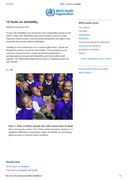
People with disabilities are among the most marginalized groups in the world. People with disabilities have poorer health outcomes, lower education achievements, less economic participation and higher rates of poverty than people without disabilities.
Fact Book on WHO Level I and Level II monitoring indicators - To monitor the progress of efforts to improve the global medicines situation, WHO has developed a system of indicators that measure important aspects of a country’s pharmaceutical situation. Level 1 indicators measure the existence and ...
Project protocol
Introduction Ready-to-eat food sold in the street represents a global phenomenon, more common in urbanized areas, that constitutes an important dietary source in populations from low- and middle-income countries. However, research on the kind of street food offered and its composit...

WHO supports Zambia in vaccinating 1 million people in Lusaka against cholera to combat an outbreak that began in October 2017, causing 2,672 cases and 63 deaths. Two million vaccine doses were provided by Gavi. WHO and the Zambia National Public Health Institute are improving water access, sanitati...
Over the past decade, the reduction of maternal mortality in Latin America and the Caribbean has shown signs of a marked slowdown and in some cases a reversal, jeopardizing commitments made at the global and regional levels and by the Member States themselves, including those established in the Sust...
Global HIV Strategic Information Working Group

This country cooperation strategy (CCS) outlines how the World Health Organization (WHO) will work with the Lao People’s Democratic Republic over the next five years (2024–2028), supporting the implementation of the five-year health sector development plans and the Health Sector Reform Strategy ...
