
Filter
10830
Filtered Results: 10830
Text search:
health
action
Featured
Recommendations
901
New Publications
2600
Language
Document type
No document type
5563
Studies & Reports
1962
Guidelines
1353
Manuals
641
Strategic & Response Plan
515
Fact sheets
275
Training Material
238
Situation Updates
102
Resource Platforms
58
Infographics
47
Brochures
44
Online Courses
15
Videos
14
Dashboards/Maps
2
App
1
Countries / Regions
Global
545
India
377
Kenya
268
Latin America and the Carribbean
230
Ethiopia
195
Sierra Leone
191
South Africa
191
Nigeria
186
Western and Central Europe
180
Uganda
180
Nepal
177
Myanmar / Burma
163
Liberia
153
Africa
147
Bangladesh
145
Malawi
131
Congo, Democratic Republic of
122
Syria
121
Zambia
121
Tanzania
117
Ukraine
105
Rwanda
105
Senegal
101
Ghana
95
Namibia
86
Philippines
84
Eastern Europe
77
Haiti
72
Venezuela
71
Paraguay
71
South Sudan
71
Colombia
68
Indonesia
65
Guinea
64
Mozambique
63
Burkina Faso
62
South–East Asia Region
62
Zimbabwe
59
Lesotho
57
Cambodia
57
Asia
57
Russia
57
Germany
52
West and Central Africa
48
Middle East and North Africa
48
Yemen
47
East and Southern Africa
45
Cameroon
43
Brazil
43
Peru
41
Argentina
38
Botswana
38
Benin
37
Afghanistan
37
Central African Republic
35
Pakistan
34
Chile
33
Eastern Europe and Central Asia
33
Eswatini/ Swaziland
30
Ecuador
29
Lebanon
26
Bolivia
24
Madagascar
24
Jordan
23
Vietnam
22
Somalia
22
Thailand
21
Western Pacific Region
20
Sudan
20
Mali
20
China
17
Côte d’Ivoire / Ivory Coast
17
Sri Lanka
17
Iraq
16
North America
15
Laos
14
Moldova
14
USA
13
Mexico
12
El Salvador
12
Togo
12
Tajikistan
11
Turkey
11
Albania
11
Niger
11
Spain
11
Angola
11
Honduras
9
Chad
9
Iran
8
Burundi
8
Guatemala
8
Southern Africa
7
Palestine
7
Georgia
7
Libya
7
Timor Leste/ East Timor
6
Gambia
6
Guinea-Bissau
6
Portugal
6
Bhutan
6
North Macedonia
5
Kyrgyzstan
5
Malaysia
5
Dominican Republic
5
Ireland
5
Jamaica
5
Japan
5
United Kingdom
5
Papua New Guinea
5
Nicaragua
5
Egypt
5
Romania
5
Greece
5
Switzerland
4
Serbia
4
Uruguay
4
Turkmenistan
4
Belarus
4
Poland
4
Kazakhstan
3
Canada
3
Fiji
3
Morocco
3
Italy
3
Armenia
3
Croatia
3
Hungary
3
France
3
Mauritius
3
Bosnia and Herzegovina
3
Guyana
3
North Korea
2
Singapore
2
Congo-Brazzaville
2
Vanuatu
2
Mongolia
2
Lithuania
2
Saudi Arabia
2
Belgium
2
Tunisia
2
Azerbaijan
2
Israel
2
Australia
1
Estonia
1
Uzbekistan
1
Austria
1
Qatar
1
Bulgaria
1
Mauritania
1
Gabon
1
Denmark
1
Maldives
1
South Korea
1
French Guyana
1
Latvia
1
Belize
1
Costa Rica
1
Panama
1
Djibouti
1
Slovakia
1
Solomon Islands
1
Cuba
1
Authors & Publishers
Publication Years
Category
Countries
3915
Key Resources
711
Clinical Guidelines
618
Public Health
600
Women & Child Health
592
Capacity Building
227
Pharmacy & Technologies
74
Annual Report MEDBOX
3
Toolboxes
COVID-19
930
Mental Health
872
HIV
705
TB
507
Planetary Health
507
Disability
465
AMR
377
Conflict
304
Caregiver
299
Ebola & Marburg
276
NTDs
266
Global Health Education
243
NCDs
230
Refugee
229
Rapid Response
204
Pharmacy
168
Malaria
165
Natural Hazards
157
Health Financing Toolbox
142
2.0 Rapid Response
124
Cholera
77
Zika
72
Polio
65
Specific Hazards
63
Social Ethics
56
Typhoon
6
South Sudan
2
At present at least 2.2 billion people around the world have a vision impairment, of whom at least 1 billion have a vision impairment that could have been prevented or is yet to be addressed. The world faces considerable challenges in terms of eye care, including inequalities in the coverage and qua...

The South African WHO Country Cooperation Strategy (CCS) 2023–2027 focuses on four key strategic priorities based on the country’s health needs and disease epidemiology, while also considering the need for building resilient health systems for UHC and health security in the post pandemic period....
This analytical report reviews and discusses the potential role and influence of political commitment in implementing endorsements and conducting policy in the field of tuberculosis (TB) prevention and care. It promotes discussion by comparing and analysing the extent to which selected international...
To assess national-level responses to NCDs, WHO has implemented NCD country capacity surveys periodically since 2001. This report is the latest in that series. Since the first survey round, the NCD Country Capacity Survey (NCD CCS) has been conducted a further seven times, most recently in 2021. In ...

Diabetes is a serious, chronic disease that occurs either when the pancreas does not produce enough insulin (a hormone that regulates blood sugar, or glucose), or when the body cannot effectively use the insulin it produces. Diabetes is an important public health problem, one of four priority noncom...
These guidelines present evidence-based recommendations and best practice statements on use of medically important antimicrobials in food-producing animals, based on the WHO list of critically important antimicrobials for human medicine (WHO CIA List). These guidelines aim primarily to help preserve...
Childhood cancer is curable for the vast majority of children when essential diagnostic, therapeutic and supportive care services are accessible. However, profound inequalities in outcomes exist within and between countries with as few as 20% or 30% of children living in low- and middle-income count...
After years of relative calm, Zimbabwe has been grappling with a cholera outbreak since 12 February 2023. This resurgence is not an isolated incident, as 10 more countries (Malawi, Mozambique, Somalia, Kenya, Ethiopia, Zambia, South Sudan, Burundi, Tanzania and South Africa) in Eastern and Southern ...
The Summary of the Global status report on road safety 2023 shows that the number of annual road traffic deaths has fallen slightly to 1.19 million. The report shows that efforts to improve road safety are having an impact, and that significant reductions in road traffic deaths can be made if proven...
Pneumonia kills more children than any other illness – more than AIDS, malaria and measles combined. Over 2 million children die from pneumonia each year, accounting for almost 1 in 5 under five deaths worldwide. Yet, little attention is paid to this disease. This joint UNICEF/WHO report examines ...
This technical report presents the results of a cross-sectional survey conducted in Bishkek, Kyrgyzstan, between June and July 2016, as part of the FEEDcities Project – Eastern Europe and Central Asia. The aim was to describe the local street food environment: the characteristics of the vending si...
These guidelines provide new and updated recommendations on the use of point-of-care testing in children under 18 months of age and point-of-care tests to monitor treatment in people living with HIV; the treatment monitoring algorithm; and timing of antiretroviral therapy (ART) among people living w...
The objectives of the meeting were to agree on coordinated and aligned support to the 3 countries’ national health recovery plans (Guinea, Liberia, Sierra Leone); to identify cross-cutting areas and opportunities for integration; to identify ways to improve implementation modalities; and to identi...
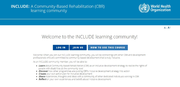
Accessed Online July 2018 | Website where, after you log in, you can join the INCLUDE learning community. Here you can connect with other CBR and development professionals who are committed to community-based development that is truly inclusive. After logging in, as an INCLUDE community member, you ...

The Water and Sanitation for Health Facility Improvement Tool (WASH FIT) presents a framework and acts as a guide to support multisectoral action to improve water, sanitation and hygiene (WASH) in health care. Central to the WASH FIT methodology is training and incremental improvements.
Implementat...

Le secteur de la santé a beaucoup évolué au cours des 20 dernières années. Les innovations technologiques ainsi que notre connaissance des maladies ont contribué à allonger l’espérance de vie au 20ème siècle. Cependant, l’un des plus grands défis
aujourd’hui n’est pas de rester a...
This handbook builds on lessons learned from surveys implemented 2015-2017 and advice provided by the Global task force on TB patient cost surveys. It provides a standardized methodology for conducting health facility-based cross-sectional surveys to assess the direct and indirect costs incurred by ...
Les présentes orientations de l’OMS portent sur la restriction du marketing (notamment le marketing numérique) dans les contextes des produits du tabac et des produits à base de nicotine, de l’alcool, des aliments et des boissons nocifs pour la santé, ainsi que des substituts du lait materne...
Policy brief, 24 July 2020
The COVID-19 pandemic has affected older people disproportionately, especially those living in long-term care facilities. In many countries, evidence shows that more than 40% of COVID-19 related deaths have been linked to long-term care facilities, with figures being as h...
L’objectif général de ce cadre est de permettre à l’OMS et à ses États Membres d’assurer la participation significative des personnes vivant avec des maladies non transmissibles, des problèmes de santé mentale et neurologiques, via un processus de cocréation et de renforcement des poli...
