
Filter
7071
Filtered Results: 7071
Text search:
Community
Health
Committee
Featured
Recommendations
608
New Publications
2004
Language
Document type
No document type
4056
Studies & Reports
1218
Guidelines
809
Manuals
392
Strategic & Response Plan
313
Training Material
93
Fact sheets
87
Situation Updates
67
Resource Platforms
15
Infographics
12
Brochures
7
Online Courses
2
Countries / Regions
India
301
Global
298
Kenya
225
Uganda
170
South Africa
167
Sierra Leone
164
Nepal
162
Nigeria
146
Myanmar / Burma
145
Liberia
144
Ethiopia
140
Western and Central Europe
118
Bangladesh
117
Malawi
115
Rwanda
111
Zambia
103
Syria
102
Ghana
92
Africa
89
Tanzania
85
Namibia
78
Latin America and the Carribbean
77
Congo, Democratic Republic of
74
South Sudan
66
Ukraine
65
Philippines
60
Lesotho
52
Cambodia
52
Eastern Europe
52
Mozambique
50
Zimbabwe
49
South–East Asia Region
46
Guinea
45
Asia
42
Indonesia
41
Senegal
40
Burkina Faso
35
West and Central Africa
33
East and Southern Africa
33
Botswana
33
Yemen
32
Russia
30
Afghanistan
29
Haiti
28
Venezuela
26
Middle East and North Africa
25
Cameroon
24
Eastern Europe and Central Asia
23
Central African Republic
23
Lebanon
21
Brazil
21
Pakistan
21
Eswatini/ Swaziland
20
Jordan
19
Germany
19
Colombia
18
Benin
18
Thailand
16
Vietnam
16
Sudan
16
China
15
Mali
15
Tajikistan
14
Somalia
14
Laos
13
Western Pacific Region
13
Sri Lanka
13
Albania
11
Iraq
11
USA
10
Moldova
10
Palestine
9
Angola
9
Madagascar
9
Guinea-Bissau
8
Mexico
7
Togo
7
Kyrgyzstan
7
Niger
7
Peru
7
Southern Africa
7
Timor Leste/ East Timor
6
Burundi
6
North America
6
Côte d’Ivoire / Ivory Coast
6
Papua New Guinea
6
Georgia
6
Poland
6
Chad
6
Gambia
5
Kazakhstan
5
Iran
5
Paraguay
5
Argentina
5
Libya
5
Serbia
4
Turkey
4
Chile
4
Hungary
4
Romania
4
Bhutan
4
Ecuador
4
North Macedonia
3
Canada
3
Fiji
3
Armenia
3
Turkmenistan
3
Jamaica
3
Japan
3
Mauritius
3
United Kingdom
3
Portugal
3
Belarus
3
Bosnia and Herzegovina
3
Bolivia
3
Greece
3
El Salvador
2
Singapore
2
Malaysia
2
Mauritania
2
Italy
2
Croatia
2
Lithuania
2
Azerbaijan
2
Egypt
2
Honduras
2
Guatemala
2
North Korea
1
Switzerland
1
Estonia
1
Uzbekistan
1
Vanuatu
1
Morocco
1
Qatar
1
Bulgaria
1
Dominican Republic
1
Saudi Arabia
1
Gabon
1
Denmark
1
Belgium
1
Maldives
1
Norway
1
Spain
1
Israel
1
Guyana
1
Slovakia
1
Authors & Publishers
Publication Years
Category
Countries
2870
Key Resources
497
Clinical Guidelines
411
Public Health
383
Women & Child Health
368
Capacity Building
123
Pharmacy & Technologies
35
Toolboxes
Mental Health
500
COVID-19
479
HIV
477
Disability
364
TB
304
Conflict
256
Ebola & Marburg
223
Planetary Health
218
AMR
209
Caregiver
184
Refugee
163
NTDs
157
Rapid Response
143
Global Health Education
112
NCDs
111
Pharmacy
110
Natural Hazards
108
Health Financing Toolbox
85
Malaria
78
2.0 Rapid Response
77
Polio
47
Cholera
37
Specific Hazards
35
Social Ethics
35
Zika
35
Typhoon
6
South Sudan
1

Since the discovery of insulin nearly 100 years ago, advances in diabetes treatments and therapies have transformed the lives of people
with diabetes (PwD), notably reducing the daily burden of its management.
Newer technologies, including those driven by artificial intelligence, have the potentia...
Over the last decade, there have been numerous disasters and major emergencies that have profoundly impacted the lives of millions of people worldwide. To support these crises, national and international emergency medical teams (EMTs) are often deployed to assist disaster affected populations. EMTs ...
The handbook on supply chain management for HIV/AIDS commodities was written to assist program managers to plan and implement day–to-day management of all drugs and medical supplies for an HIV/AIDS program. Many of the suggested techniques described in this handbook are helpfu...
ICTC’s 2022-2030 strategic plan spans the critical period running to the end of 2030, the year by which we are striving to achieve the elimination of trachoma as a public health problem. This strategic plan is in alignment with the NTD road map, Ending the neglect to attain the Sustainable Develop...
Latin America and the Caribbean is characterized by a matrix of social inequality whose axes —such as
socioeconomic stratum, gender, stage in the life cycle, ethnicity and race, territory, disability, and immigration
status— create multiple, often concurrent, situations of exclusion and discri...
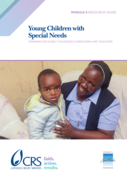
MODULE 5 RESOURCE GUIDE | This guide is part of a series of manuals that focuses on six topics in Early Childhood Development (ECD): different programming approaches, basic concepts, assessments, early childhood environments, children with special needs and child protection, and the health, safety a...

The African Palliative Care Association is pleased to publish the first edition of Palliative Care Standards for Africa. The development of these standards was achieved through wide consultation with service beneficiaries and providers, and they have been developed to suit different levels of ...

The Joint Response Plan sets out a comprehensive programme shaped around three strategic objectives – deliver protection, provide life-saving assistance and foster social cohesion. The Plan covers all humanitarian sectors and addresses key cross-cutting issues, including protection and gender main...
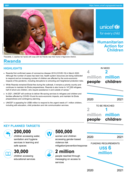
Rwanda first confirmed cases of coronavirus disease 2019 (COVID-19) in March 2020. Although the number of cases has been low, health system resources are being redirected to respond and an increasing number of children are affected by the socio-economic impacts of the pandemic, including disruptions...
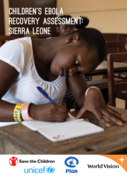
Nearly half the population of Sierra Leone is under the age of 18 years and the impact of the Ebola crisis on their lives now and on their future opportunities has been far-reaching: no school; loss of family members and friends to the virus; and changing roles and responsibilities in the home and t...
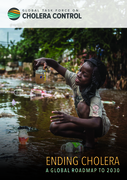
Ending Cholera. A global roadmap to 2030
recommended
Ending Cholera—A Global Roadmap to 2030 operationalises the new global strategy for cholera control at the country level and provides a concrete path toward a world in which cholera is no longer a threat to public health

Integrated Outbreak Analytics (IOA) applies a multidisciplinary approach to understanding outbreak dynamics and to inform outbreak response. It aims to drive comprehensive, accountable, and effective public health and clinical strategies by enabling communities, and national and subnational health a...
Infectious diseases are constantly in transition. New diseases develop, known dis-eases become widespread or reemerge, and occasionally a disease is eradicated.Infectious diseases such as HIV, tuberculosis, and cholera are significant causes ofillness and death in many parts of the world. Health car...
Am. J. Trop. Med. Hyg., 106 (Suppl 5), 2022, pp. 56–60. Lymphatic filariasis (LF) is a parasitic disease that is a major cause of chronic disability in the developing world. According to the 2021–2030 road map for neglected tropical diseases (NTDs) published by the World Health Organization (WHO...
Namibia is estimated to be at 94-97-93 as defined by the UNAIDS 95-95-95 treatment cascade, one of the first high burden countries to approach epidemic control. COP22 is about sustaining the impact of years of investment and partnership with the Namibian government and other stakeholders by employin...

It is now well known that there is a pandemic of Type 2 Diabetes in the world particularly in developing countries. This fact has several implications for the health care system in the developing countries because this condition is associated with metabolic and vascular complications which in turn i...

Preventing tuberculosis infection from progressing to tuberculosis disease is a crucial component of the goal to eliminate tuberculosis. When deciding on the use of tuberculosis preventive therapy among household contacts, policy makers regularly ask questions, such as whether tuberculosis preventiv...
This guidance document is based on research of social media activity related to antibiotic use at EU level, as well as on a survey of the social media activities of EAAD partner organisations, mostly EU umbrella organisations of patients and health professionals. The research showed that there is al...
PEPFAR Malawi’s Country Operational Plan (COP) 2021 reflects a culmination of strong interagency collaboration between the PEPFAR Malawi team, Government of Malawi (GoM), and civil society organizations (CSOs) to mitigate the devastating impacts of COVID-19 and sustain progress achieved over the l...
Taking the whole of Africa approach to fighting the COVID-19 pandemic has and will continue to require coordinated efforts from multiple stakeholders from across the continent. Africa CDC would like to acknowledge the deep partnership and continued support of AUDA-NEPAD, AVAREF, WHO AFRO, the Bill a...
